Game-related ramblings.

Tag: Free Page 4 of 6

Indie Time: Poacher

Most people know Ben “Yahtzee” Croshaw for his fast-talking, foulmouthed and often hilarious Zero Punctuation video reviews of various games, but he’s also made a few games of his own. Long before starting Zero Punctuation he made several point and click adventure games with Adventure Game Studio, the most famous of which comprise the four-game John DeFoe series (aka the Chzo Mythos series), beginning with 5 Days a Stranger. He even managed to create a few platformers with Adventure Game Studio, including Trilby: The Art of Theft, a stealth platformer with a different style to Stealth Bastard that’s well worth checking out. Like the rest of his games, it’s available for free.

Lately, Yahtzee’s efforts have been focused on Zero Punctuation and writing a novel, but he did find time to make Poacher, an exploration platformer starring “unflappable Yorkshireman” Derek Badger. Indeed, Yahtzee was apparently inspired by a google image search result for “Yorkshireman” (a result I was sadly unable to reproduce, but then I am in a different country). Being a fan of exploration platformers and of Yahtzee’s earlier work, I decided to check it out.
Roguelike-like: Decker

There are some who consider Decker to be a true roguelike, but I found it played so differently to traditional roguelikes that I hesitate to call it one, exactly. But it certainly draws inspiration from roguelikes, and the end result is quite interesting.

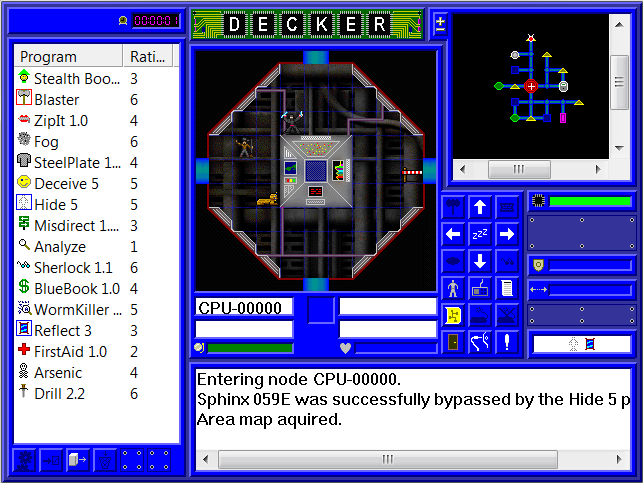
You see, Decker is a game about hacking. Not hacking and slashing, as most roguelikes are, but hacking as in breaking into computer systems and stealing files. Drawing heavy inspiration from William Gibson’s Neuromancer, it casts the player as the titular Decker, a 22nd century hacker who is contracted to cruise through the virtual reality of the Matrix and steal valuable data. It lets you lead a dangerous but alluring life of corporate espionage and high-tech gadgetry. Well, eventually. In the beginning you are living in poverty, have a bare-bones cyberdeck (read: futuristic computer used for hacking purposes), and can only get a job breaking into the local Radioshack computer system to reset someone’s sick days, or something. A smart Decker doesn’t ask for the details. As you gain cash and a reputation, however, more meaty jobs start to appear, and you can upgrade your hardware and software to tackle some higher-security systems. This is the first and most obvious way that Decker differs from traditional roguelikes: rather than exploring a single dungeon or world, the player will tackle many different procedurally-generated computer systems, connected by an overarching time management game that lets one divide time between writing new programs, resting to recover from injury (yes, you can be physically injured when you’re jacked into cyberspace), or completing contracts in order to make rent at the end of the month.

Indie Time: Treasure Adventure Game

I decided to try Treasure Adventure Game after it suddenly showed up for free in my GOG.com account. But don’t worry if you don’t have a GOG account — you can grab it for free directly from the creator as well.

Billed as a retro-styled exploration-based platformer in the vein of classics like Super Metroid, Treasure Adventure Game certainly contains a lot of old-school design elements that might put off some players. There’s a lot of backtracking… seriously, a lot of it. There is a system for fast-travel but it’s not introduced until late in the game and is not very obvious; I didn’t even find out about it until after I finished the whole thing. There are many jumping puzzles where the player can fall and lose significant progress, leading to frustration after missing the last jump in a long sequence. Saving is only possible at special save points, meaning more lost progress after dying. But despite all of this I found I was enjoying myself immensely.

Indie Time: Stealth Bastard

I’ve been meaning to play Curve Studios’ Explodemon! ever since it was ported to PC, but I haven’t gotten to it yet. I did, however, find time to play their more recent Stealth Bastard, which has the advantage of being completely free. With the tagline “Tactical Espionage Arsehole”, Stealth Bastard asks the question, “why do stealth games have to be so… slow?”

Why, indeed.

Roguelike Updates: New Versions of DoomRL, Dungeon Crawl and Brogue

Several of the games I’ve covered in my Roguelike Highlights series have recently received some major updates. First up is DoomRL v0.9.9.6 (read my highlight of DoomRL here). DoomRL is, of course, a roguelike based on Doom, and the new version is the first to include a graphical tileset (although the original ASCII graphics can still be used). The graphics, incidentally, are made by Derek Yu, the same man responsible for Spelunky. There are several gameplay and balance changes as well; the full changelog is here, and you can see some shiny new screenshots here.

Roguelike Highlights: Xenocide

EDIT: A WordPress update seems to have messed up the screenshots in this post, and re-uploading them isn’t helping; they do not show up properly in WordPress at all anymore. Plus the original link to the game is down. So you’ll just have to trust me that this game exists at all.

New readers may want to read my introduction to roguelikes first. Previous roguelike highlights can be found here.

Xenocide is not finished. And with no updates since 2007, it seems unlikely that it ever will be. There is no ending, with things simply trailing off if you get far enough, and there are many item descriptions and even some gameplay features that haven’t been implemented. As such, it’s not a game that one will play for very long. But it has a lot of really clever ideas, and I think some of the more popular roguelikes could learn a lot from Xenocide.

Final Thoughts on Master of the Wind

I first wrote about Master of the Wind some time ago. That was mostly from memory. Master of the Wind was released episodically, and I played through the first five story arcs a few years ago. I played the sixth upon release, but there was a long wait for the seventh and final arc, so when it arrived I decided to start over from the beginning. Now I have finished a fresh, full playthrough of the entire thing, so I can offer my final thoughts on the game.

As I mentioned before, Master of the Wind is a free game made with RPGMaker, a game-making tool designed for the creation of Japanese-style RPGs (JRPGs) in the vein of those from the 8-bit and 16-bit console era. Master of the Wind does not defy many conventions of these games, with its pre-set cast of characters, turn-based battle system and completely linear story. But it sets itself apart through its excellent writing and characterization.

Roguelike Highlights: Tales of Maj’Eyal

[If you are unfamiliar with roguelikes, consider reading my introduction to the genre. You can read previous Roguelike Highlights here. As always, click on screenshots to view bigger versions.]

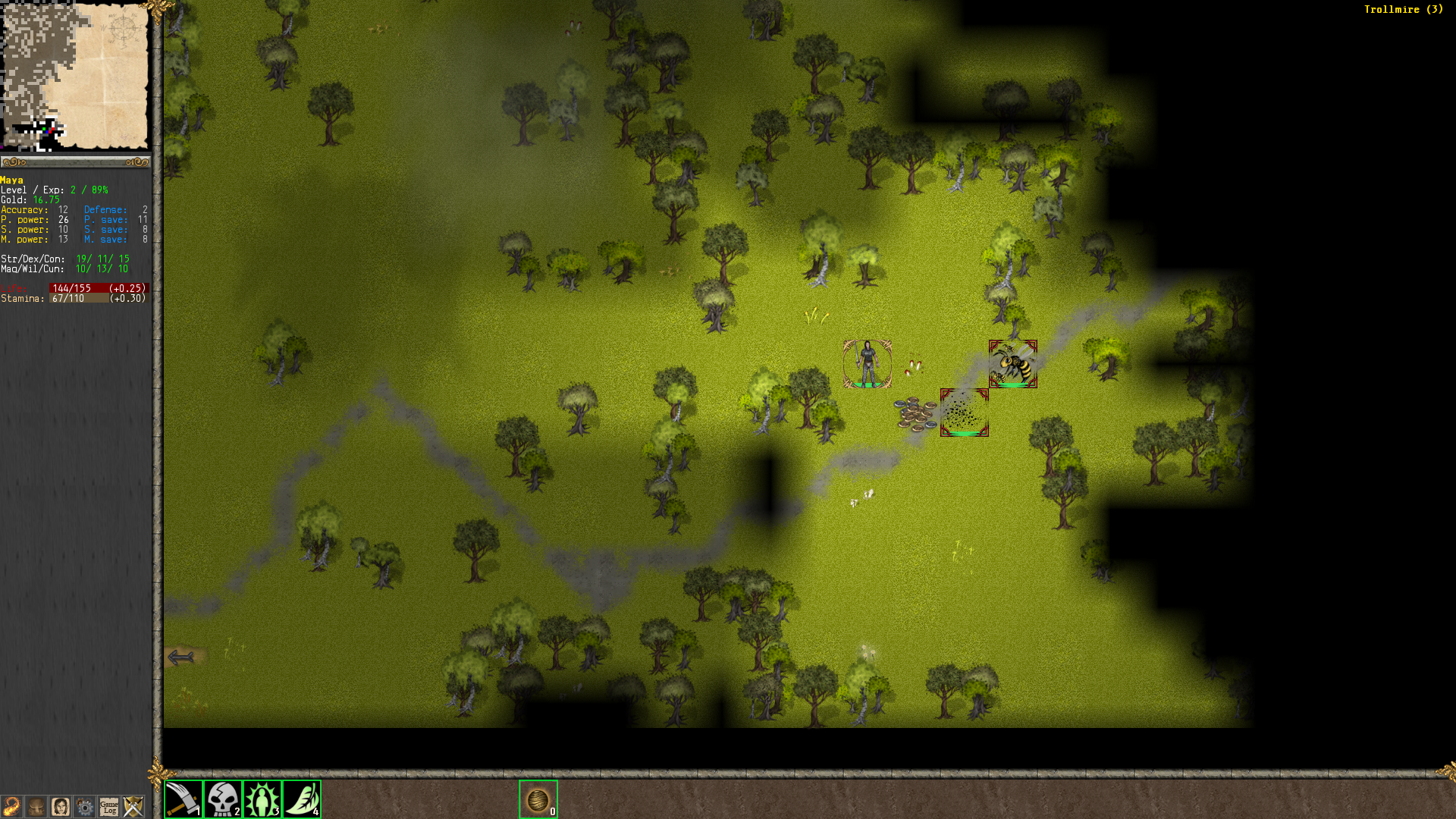
In the year when Dungeons of Dredmor was released to critical acclaim, topped the Steam sales charts for a while, and introduced a whole bunch of people to the roguelike genre, I was somewhat surprised to discover that it did not win the ASCII Dreams Roguelike of the Year award for 2011. Instead, a game I had never heard of took the prize: Tales of Maj’Eyal, a.k.a. ToME 4. Upon further investigation I discovered the the award is simply given to the game that receives the most votes from its fans, and that indeed one can easily vote twice or for several different games. Still, the fact that ToME 4 took the prize for the second year running indicates a very devoted fanbase, so I decided it was time to check it out.

I’m glad I did, because ToME 4 is actually one of the more unusual roguelikes out there, with quite a lot of ideas and mechanics I haven’t seen in other roguelikes. It’s not just a game, but also an engine, providing building blocks and tools for players to construct their own roguelikes. The game itself demonstrates the versatility of the engine, which is able to handle both traditional and non-traditional mechanics, as well as sound effects, music, and fancy sprites and graphical effects if desired. I haven’t poked around with the engine myself, so I’m not sure how easy it is to use, but it’s certainly powerful.

Roguelike-like: Spelunky

If you are unfamiliar with roguelikes, consider reading my roguelike introduction.

Spelunky is one of the best examples of games that successfully translate roguelike design elements into a different genre. In Spelunky’s case, this genre is the 2-D platformer. I was going to wait to post this until the new, updated version of Spelunky is released on X-Box Live Arcade, but that seems to be taking forever and I got impatient. The original, free version of Spelunky is possibly the best freeware game I’ve ever played, and you should be playing it too.

Master of the Wind Is Finished

While looking for a game to play over vacation, when I’m away from my main PC, I decided to check in on Master of the Wind, and found that it’s now finished. The seventh and final arc is complete and the entire game is now available as a single download, for free.

Master of the Wind is my favorite game made with RPGMaker, a tool designed for creating old-school Japanese-style role-playing games. For those unfamiliar with the style, these games usually feature pre-set characters, a top-down viewpoint with separate turn-based battles, and an emphasis on story. I find that the most important thing for me when playing such games is the writing, and the writing in Master of the Wind is what really sets it above other games in the genre. The game’s themes include prejudice and racism, societal structure, and the true nature of justice and forgiveness, all handled artfully through the game’s narrative.

Try it out by downloading here, or read on for some more thoughts on the game.

Page 4 of 6

Powered by WordPress & Theme by Anders Norén