Game-related ramblings.

Tag: Free Page 3 of 6

Indie Time: The Wager

Ludum Dare is a recurring game development competition in which participants are given 48 hours to make a game based around the competition’s theme. The results have been surprisingly good, with the strict time limit forcing developers to focus on a solid core design for their entries, making the competition quite popular among designers and players alike. After Ludum Dare 18, a secondary competition was added called the Jam, which allows for teams and has an extended time limit of 72 hours.

The Wager was an entry in the Ludum Dare 19 Jam, with the theme of “discovery” (see the winners here). Since then, developers Surprised Man have gone back to fix bugs and add some features, and the latest version 1.2.4 is available for free from their site. The game pits the player against the dastardly Sir Lester Marwood, with whom the player has made a wager: whoever can make the most money from their maritime explorations by the end of the year 1777, wins. The player sails north, Marwood sails south. It’s on.

Indie Time: Kevin Rudd Farming Generations

I feel like I’m writing about Japanese-style role-playing games disproportionately often, compared to what I’m actually playing. I think this is because, like roguelikes, they make excellent “break time” games that can be played in short, quick sessions and don’t require a significant time investment. While I’m always playing at least one large-scale game, I can’t always sit down for a serious gaming session, and sometimes these “break time” games are all I have time for. I hope to post about the other stuff I’m playing soon, but it may be small-scale games for a while.

Kevin Rudd Farming Generations is a Japanese-style role-playing game made using RPGMaker [EDIT: It was actually made using GameMaker]. I can confirm that it involves both farming and generations.

Indie Time: Moustache King Adventure

My wrist has recovered enough to allow me to play two-handed games again! I’m playing a few at the moment, but I’m not ready to write about them yet, so I wasn’t sure what to post about. Then I played Moustache King Adventure.

Moustache King Adventure was an entry in the latest A Game By Its Cover competition, in which developers must make a game based on a fake game cartridge (in this case, it was this cartridge). The first A Game By Its Cover competition was hosted over at Tigsource (an indie games site run by Derek Yu, of Spelunky fame), and brought us such classics as Cat Poke and Under the Garden (which is, incidentally, getting a full-blown sequel called Under the Ocean). It seems that the A Game By Its Cover competition has since spun out on its own, with a dedicated website and everything. In this second contest, entrants had one month to make their games from scratch, so most of the games are simple and short. Moustache King Adventure is no exception, but it’s an enjoyable way to spend a few hours. It also has 400% more moustaches than the average game.

Roguelike Highlights: Mercury

If you haven’t already, you may wish to read my Introduction to Roguelikes. Previous Roguelike Highlights can be found here.

I’ve been pretty busy recently so I haven’t had much time to post, but I wanted to at least write something quick about Mercury. While most Roguelike Highlights are fairly long and detailed, this one doesn’t have to be, because of the central premise of Mercury. It’s a winner-generated roguelike. Rather than being continuously updated by the developer, as most roguelikes are, Mercury instead tracks players’ high scores, and at the end of each cycle (I think cycles are two weeks long but I’m not sure) the two players with the highest scores can add a new character class, monster, or item to the game. Then everyone plays with the new stuff for the next cycle, and the new high scorers will get to add more stuff when that cycle ends.

That means that Mercury started off as a very simple game, with only one character class, one type of monster, and one item. Since then, it’s grown quite a bit.

Roguelike Highlights: POWDER

If you haven’t already, you may wish to read my Introduction to Roguelikes. Previous Roguelike Highlights can be found here.

I’ve been meaning to check out POWDER for some time, having heard good things from many sources, including comments on this blog. Originally released by Jeff Lait for the Gameboy Advance and Nintendo DS, POWDER has since been ported to Windows, Linux, Max OSX, Wii, Playstation Portable (although that’s an old version), iPhone and even GP2X. With the most recent version (release 117) arriving in December 2011, it seems that POWDER is still very much alive. Which is good, because in my time with it I’ve been quite impressed. Given its origins on handheld devices, I was expecting something fairly basic, but POWDER is actually a very deep and nuanced game that draws on some of the best elements of other roguelikes to create its own unique feel.

It certainly made me feel silly for being prejudiced against handheld games.

Indie Time: You Have To Win The Game

I’ve been rather busy, and can only find time for shorter posts. Fortunately, a short post is perfect for You Have To Win the Game. Released for free just a couple of months ago by J. Kyle Pittman (who spends his days working for Gearbox), You Have To Win the Game is a clear homage to games of yore, complete with a 4-color palette and a cool effect that simulates the curved surface of an old cathode ray tube monitor. The gameplay is that of a traditional exploration platformer, with players guiding the protagonist through a variety of screens collecting items and dodging enemies. Fans of classic games from the 1980s will certainly get a nostalgic kick out of it.

But I think the appeal of You Have To Win the Game is wider than that. It manages to capture much of what made those old games interesting in a way that new players can appreciate. As I explored the caverns of You Have To Win the Game I felt the same sense of wonder I once felt when playing Another World, where there was no telling what each new screen would hold. Modern games, for all their advances, often fail to capture that feeling, which was so common in the early days. Later, as I began to get my bearings, I felt a particular satisfaction in discovering just how all the pieces of the world fit together. It wasn’t simply mapping out the environment, it was seeing the way all the parts formed a cohesive whole; the same thing greatly impressed me when I played Might and Magic: Book One. The game centers on this strong world design, requiring the player to pay close attention to the environment in order to work out how to win.

Sure, I’m an older player who certainly feels nostalgia for classic games, but I think that anyone could appreciate these aspects of You Have To Win the Game. If you’ve ever been interested in why so many people pine for the games of their youth, give You Have To Win the Game a try, and it might help you understand. You can download the game for free from the author’s site.

Indie Time: Iffermoon

A while back I posted about The Desolate Room, a game that never quite grabbed me. I’ve argued before that bad games can still be worth playing if they’re interesting enough, and there were in fact some interesting mechanics at the hart of The Desolate Room, but the game’s flaws outweighed these for me. I was left, however, with an interest in checking out the newer offerings from ScottGames, like the fairly recent sequel, The Desolate Hope. But rather than jump right to their most recent release, I decided to go through the ScottGames catalog in order, which meant starting with their next game, Iffermoon.

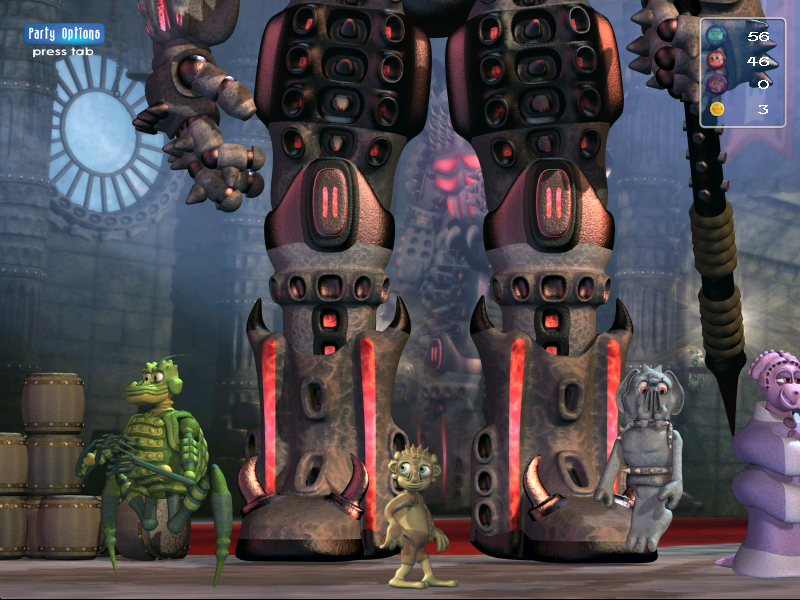
Iffermoon, like The Desolate Room, could be classified as a Japanese-style role-playing game due to its party-based, separate-screen battle system full of charge bars and special abilities. But that’s pretty much where the similarities end. Outside of combat, the player guides Silence, the young protagonist, through the various locales of the planet of Dinostria in side-scrolling fashion, stopping to chat with the diverse inhabitants and collecting various items along the way. There’s no real platforming; the side-view is merely the method for traveling around, and acts as a showcase for the strikingly imaginative and beautiful locations as well as some really fantastic character designs for the people you will meet. These, as well as the rather unorthodox story, were the main draws for me.

Indie Time: Chain of Retribution (part 2)

This is my second post about the “chain game” Chain of Retribution, which was developed by seven people in succession, each passing on their work to the next. If you haven’t done so already, you should probably read part one here.

The mystery is gone. I had been working my way through Chain of Retribution trying to guess where the changeovers were, to see if I could detect the influence of a new author or if it would fit so seamlessly that I couldn’t tell. But then, as I approached the game’s finale, I stumbled upon a room where all was revealed, where the authors speak directly to the player about their roles in the project. Given that trying to suss out each person’s involvement was my favorite part of the game, I don’t want to spoil the reveal here, but I can say that there were indeed some changeover points that I completely missed while playing. Sadly, though, this meant I had to face the endgame already knowing who had been involved in making it. But I was pleasantly surprised at how enjoyable it was.

Indie Time: Chain of Retribution (part 1)

I first read about Chain of Retribution over at IndieRPGs, and at first it looked like a fairly standard Japanese-style role-playing game made using RPGMaker. But what caught my attention is that it is apparently a “chain game”, meaning that one developer worked on it and then passed it on to another, who continued working on it, before passing it on again, and so forth. Apparently a total of seven people worked on the game in succession to create the final product.

This intrigued me. How would it work? Did the developers plan everything out beforehand? Or did each one write the next part of the story themselves? Would the game veer off in a completely different direction than the first developer intended? Was there any collaboration on gameplay systems and graphics, or was that all set up by the first person in line? The web page for the game doesn’t answer any of these questions, so I decided to try the game and see for myself.

One That Got Away: The Desolate Room

Several weeks ago I saw a post on the IndieGames.com blog about The Desolate Hope, a new freeware game from ScottGames. My first thought was, “is this a sequel to The Desolate Room?” And indeed it is.

The Desolate Room is a very odd freeware role-playing game that I heard about several years ago. With a cool art style and a coffeepot robot protagonist who delves into the memory chips of the other wrecked robots on his tiny island, it certainly seemed intriguing. But I didn’t get far before giving up in frustration. Lots of little aspects of the design combined to stifle my enjoyment, and the game simply never clicked with me.

I did, however, remain intrigued by it. It was one of those games that I wanted to like, just because it’s so different and peculiar, so it stuck in my memory despite the problems I had with it. With the sequel garnering no small praise from a few critics, I decided perhaps it was time to revisit The Desolate Room, to see if I was right to put it down or if there’s a gem somewhere in there after all. So I gave it another go, and this time I managed to stick it out.

Page 3 of 6

Powered by WordPress & Theme by Anders Norén