Game-related ramblings.

Tag: PC Engine

Console History: Makai Hakkenden Shada (Shada, Legend Of The Eight Dogs Of Hell)

This is Console History, a special sub-series of my more general History Lessons series, covering console role-playing games, action role-playing games, Metroidvanias, and action-adventure games in nominally chronological order starting in the late 1980s. The chronology is garbled in the beginning as the scope of the series expanded, but it gets more organized later on. As always, you may click on images to view larger versions.

We’ve just completed a detour from the nominal timeline for this series. Having reached Phantasy Star II which released on March 21, 1989 in Japan, I went back to play several games I’d missed or passed over: Glory of Heracles: The Labors of the Divine Hero, Bionic Commando, Valkyrie no Densetsu, and (jumping backwards again) Golvellius: Valley of Doom. Now we’re all caught up, and proceed to April 1, 1989, when Data East released Makai Hakkenden Shada in Japan for the PC Engine. It was never localized in English, so I turned to a fan translation from cabbage, Shubibiman and onionzoo.

I’m glad I did the detour, because Data East also developed Glory of Heracles, making for a nice comparison. Unfortunately, Makai Hakkenden Shada doesn’t fare well in that comparison.

History Lessons: Valkyrie No Densetsu (The Legend Of Valkyrie)

Other History Lessons posts can be found here. If you’re looking specifically for console games, those are here. As always, you may click on images to view larger versions.

Our detour continues. If I’d managed to be chronological, then the latest post in this series would have been the one about Phantasy Star II. But I found a few games that I missed, so I went back to play them: first Glory of Heracles: The Labors of the Divine Hero, followed by Bionic Commando. Now, we’ve arrived at what was supposed to be the last game of the detour. I say “supposed to” because I already found another game I missed… but more on that later. For now, we’re talking about Valkyrie no Densetsu, which translates to The Legend of Valkyrie. Developed and published by Namco, Valkyrie no Densetsu first appeared in arcades in March 1989, placing it between Clash at Demonhead and Out Live in our timeline. A port for the PC Engine appeared in August 1990, which is the version I played. Both versions were limited to the Japanese market, however, so I used a fan translation from shawnji (AKA Shawn Cox) and cabbage to play.

Console History: Out Live

This is Console History, a special sub-series of my more general History Lessons series, covering console role-playing games, action role-playing games, Metroidvanias, and action-adventure games in nominally chronological order starting in the late 1980s. The chronology is garbled in the beginning as the scope of the series expanded, but it gets more organized later on. As always, you may click on images to view larger versions.

Reader, we are back on our nominal timeline for this series once more. In fact, this is the entry that sent me on my latest detour, investigating other Japanese-only games that were translated by the team at Nebulous Translations: Getsu Fuuma Den, Star Cruiser, and Shiryou Sensen: War of the Dead. Now I’m back to Out Live by Sunsoft, a grid-based mecha dungeon crawler role-playing game that released in Japan on March 17, 1989 for the PC Engine. That puts it almost two months after Clash At Demonhead in our timeline. It was never officially localized in English, but thankfully I was able to use the fan translation from Nebulous Translations to play it.

Console History: Shiryou Sensen: War Of The Dead

This is Console History, a special sub-series of my more general History Lessons series, covering console role-playing games, action role-playing games, Metroidvanias, and action-adventure games in nominally chronological order starting in the late 1980s. The chronology is garbled in the beginning as the scope of the series expanded, but it gets more organized later on. As always, you may click on images to view larger versions.

I’m almost finished with the latest departure from the nominal timeline for this series. It was triggered by finding several interesting Japanese-only games that have been unofficially translated by the team at Nebulous Translations, first Getsu Fuuma Den and then Star Cruiser. This time, however, it’s not my fault! Fun Project’s horror game Shiryou Sensen: War of the Dead (Undead Front: War of the Dead, according to Google Translate) was indeed a Japanese-only title that was translated by Nebulous Translations, but it was already in my list of games to play. The problem is that I wrote down the release date of its PC Engine port (March 24, 1989), not realizing that it was originally released for the Japanese MSX2 home computer sometime back in 1987! I’m trying to play games in original release date order, even if I’m actually playing a later port like the CD-ROM versions of Ys I & II or the Genesis version of Hydlide 3: The Space Memories. So I’m extending my detour to cover the PC Engine version of War of the Dead now.

Console History: Exile

This is Console History, a special sub-series of my more general History Lessons series, covering console role-playing games, action role-playing games, Metroidvanias, and action-adventure games in nominally chronological order starting in the late 1980s. The chronology is garbled in the beginning as the scope of the series expanded, but it gets more organized later on. As always, you may click on images to view larger versions.

After a brief step back in time to cover Castlevania II: Simon’s Quest, we are back on track with our timeline for this series. Sort of. Exile is technically a remake of a game called XZR II by Telenet Japan which released for Japanese home computer systems in August 1988, about two months after Lord of the Sword, but the remake (which is the only version localized in English) arrived three years later in 1991, for both the Sega Genesis and the PC Engine CD/Turbografx-CD. Having been impressed by the Turbografx-CD hardware when playing Ys I & II for this series, I opted for that version of Exile.

Console History: Ys II: Ancient Ys Vanished – The Final Chapter

This is Console History, a special sub-series of my more general History Lessons series, covering console role-playing games, action role-playing games, Metroidvanias, and action-adventure games in nominally chronological order starting in the late 1980s. The chronology is garbled in the beginning as the scope of the series expanded, but it gets more organized later on. As always, you may click on images to view larger versions.

When I first started writing about early console games, I was only planning to play through the Final Fantasy series. Then I decided I should probably go back and play the Dragon Quest series too. Then I decided I should also play a bunch of other role-playing games, and then that I should add some action role-playing games… the result was something of a mess in terms of the timeline, jumping back and forth as I kept expanding my list of games. This post, however, brings my (now massive) list back into order. My last post was about Hydlide 3: The Space Memories, which originally released on November 22, 1987. The original Final Fantasy (the very first post I wrote in this console history series) appeared about a month later, on December 18, 1987. A mere two days after that, the excellent Phantasy Star released. Next came Dragon Quest III on February 10, 1988. And, finally, that brings us to Ys II: Ancient Ys Vanished – The Final Chapter, originally released in Japan on April 22, 1988 for Japanese home computer systems like the PC-88. From here on out, we should be going in chronological order!

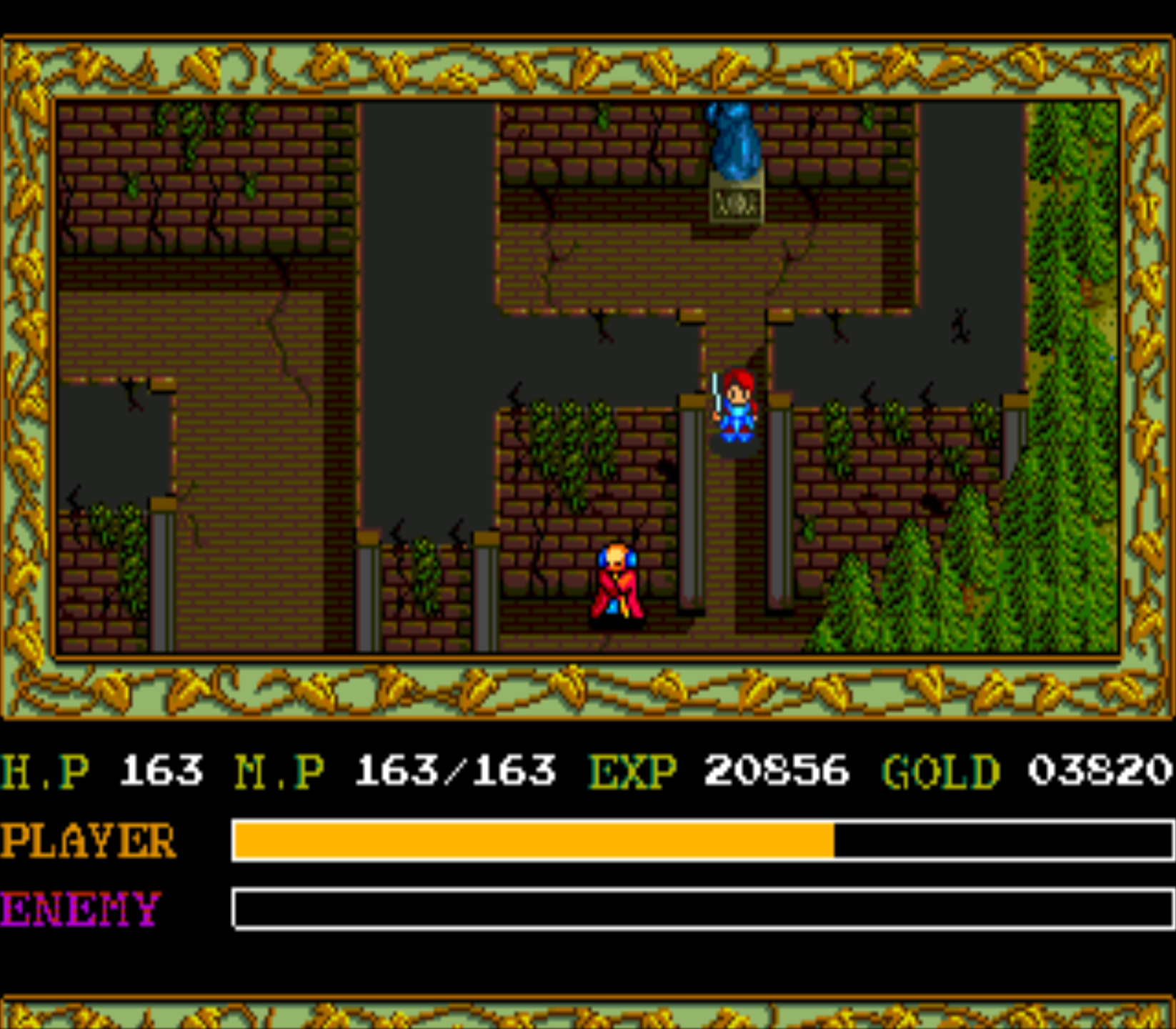
As the name suggests, Ys II is a direct sequel to the original Ys that finishes up the story. The connection is so strong, in fact, that both games were later remade and re-released as a single title, Ys Book I & II, for the PC Engine CD/TurboGrafx-CD in December 1989. That’s the version I played, and I’ve already written about Ys I. I then paused my playthrough to cover other games that released between Ys I and Ys II. Now, I’ve gone back to finish off Ys II.

Console History: Ys I: Ancient Ys Vanished

This is Console History, a special sub-series of my more general History Lessons series, covering console role-playing games, action role-playing games, Metroidvanias, and action-adventure games in nominally chronological order starting in the late 1980s. The chronology is garbled in the beginning as the scope of the series expanded, but it gets more organized later on. As always, you may click on images to view larger versions.

One of the reasons I wanted to play the early Japanese console role-playing games is that so many have become enduring series. Everyone knows the behemoth Dragon Quest and Final Fantasy franchises, which have been running for more than thirty years, but there are so many others too. Digital Devil Story: Megami Tensei, which released in 1987, spawned the Shin Megami Tensei series and its spinoff Persona series, which had new entries in 2021 and 2020, respectively. Tales of Arise was a big hit last year, the latest entry in a series that started way back in 1995 with Tales of Phantasia on the Super Famicom. And of course, we got Ys IX: Monstrum Nox in 2019, which traces its lineage all the way to Ys I: Ancient Ys Vanished in 1987.

I’m cheating a little bit with the timeline. Nihon Falcom released the first Ys game in 1987, a few months after Esper Dream (the subject of the last entry in this blog series), on NEC’s PC-88 home computer system, although ports quickly appeared for other Japanese home computers such as the X1 and MSX2, as well as Famicom and Master System ports a year later. But the version universally regarded as best among fans — not counting more modern remakes, like the 2013 version currently sold on Steam and GOG — is an enhanced remake (credited to Alfa System) from 1989 for the PC Engine (rebranded in the United Staes as the Turbografx-16) that bundles together Ys I: Ancient Ys Vanished and its sequel Ys II: Ancient Ys Vanished – The Final Chapter in a single release. This was actually the only time (again, not counting modern remakes) that Ys II was officially localized in English, which made my decision about which version to try a bit easier (although I’m waiting to play the second game until my timeline reaches its original release date). But by playing the 1989 remake instead of the 1987 original I’m making a fairly big jump in terms of technology. You see, the PC Engine version used the CD-ROM add-on, and was in fact one of the first games developed for CD-ROM.

Powered by WordPress & Theme by Anders Norén