Game-related ramblings.

Tag: Roguelike Highlights

Roguelike-like: Decker

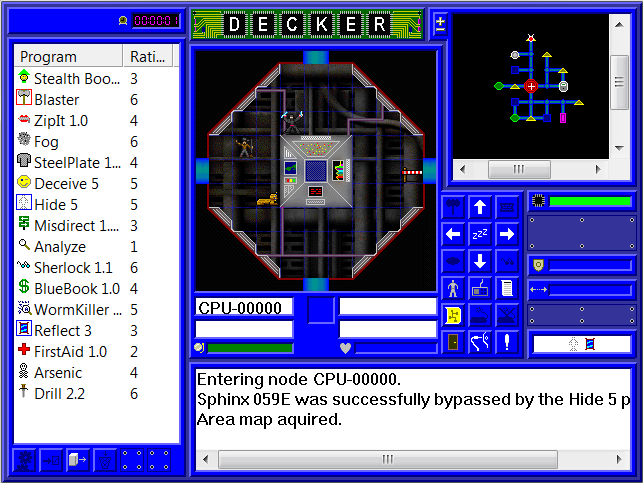
There are some who consider Decker to be a true roguelike, but I found it played so differently to traditional roguelikes that I hesitate to call it one, exactly. But it certainly draws inspiration from roguelikes, and the end result is quite interesting.

You see, Decker is a game about hacking. Not hacking and slashing, as most roguelikes are, but hacking as in breaking into computer systems and stealing files. Drawing heavy inspiration from William Gibson’s Neuromancer, it casts the player as the titular Decker, a 22nd century hacker who is contracted to cruise through the virtual reality of the Matrix and steal valuable data. It lets you lead a dangerous but alluring life of corporate espionage and high-tech gadgetry. Well, eventually. In the beginning you are living in poverty, have a bare-bones cyberdeck (read: futuristic computer used for hacking purposes), and can only get a job breaking into the local Radioshack computer system to reset someone’s sick days, or something. A smart Decker doesn’t ask for the details. As you gain cash and a reputation, however, more meaty jobs start to appear, and you can upgrade your hardware and software to tackle some higher-security systems. This is the first and most obvious way that Decker differs from traditional roguelikes: rather than exploring a single dungeon or world, the player will tackle many different procedurally-generated computer systems, connected by an overarching time management game that lets one divide time between writing new programs, resting to recover from injury (yes, you can be physically injured when you’re jacked into cyberspace), or completing contracts in order to make rent at the end of the month.

Roguelike Highlights: Xenocide

EDIT: A WordPress update seems to have messed up the screenshots in this post, and re-uploading them isn’t helping; they do not show up properly in WordPress at all anymore. Plus the original link to the game is down. So you’ll just have to trust me that this game exists at all.

New readers may want to read my introduction to roguelikes first. Previous roguelike highlights can be found here.

Xenocide is not finished. And with no updates since 2007, it seems unlikely that it ever will be. There is no ending, with things simply trailing off if you get far enough, and there are many item descriptions and even some gameplay features that haven’t been implemented. As such, it’s not a game that one will play for very long. But it has a lot of really clever ideas, and I think some of the more popular roguelikes could learn a lot from Xenocide.

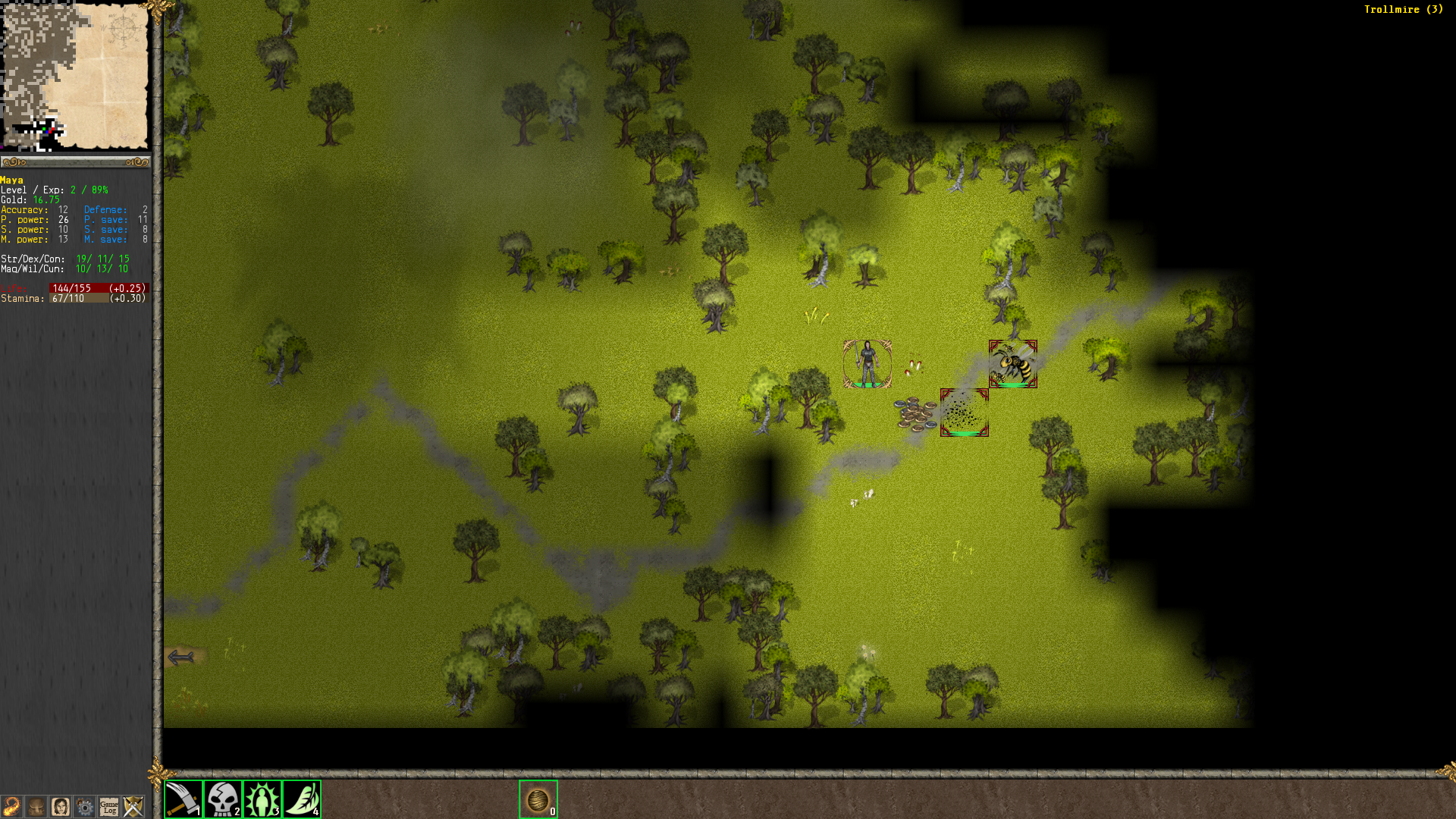
Roguelike Highlights: Tales of Maj’Eyal

[If you are unfamiliar with roguelikes, consider reading my introduction to the genre. You can read previous Roguelike Highlights here. As always, click on screenshots to view bigger versions.]

In the year when Dungeons of Dredmor was released to critical acclaim, topped the Steam sales charts for a while, and introduced a whole bunch of people to the roguelike genre, I was somewhat surprised to discover that it did not win the ASCII Dreams Roguelike of the Year award for 2011. Instead, a game I had never heard of took the prize: Tales of Maj’Eyal, a.k.a. ToME 4. Upon further investigation I discovered the the award is simply given to the game that receives the most votes from its fans, and that indeed one can easily vote twice or for several different games. Still, the fact that ToME 4 took the prize for the second year running indicates a very devoted fanbase, so I decided it was time to check it out.

I’m glad I did, because ToME 4 is actually one of the more unusual roguelikes out there, with quite a lot of ideas and mechanics I haven’t seen in other roguelikes. It’s not just a game, but also an engine, providing building blocks and tools for players to construct their own roguelikes. The game itself demonstrates the versatility of the engine, which is able to handle both traditional and non-traditional mechanics, as well as sound effects, music, and fancy sprites and graphical effects if desired. I haven’t poked around with the engine myself, so I’m not sure how easy it is to use, but it’s certainly powerful.

Roguelike-like: Spelunky

If you are unfamiliar with roguelikes, consider reading my roguelike introduction.

Spelunky is one of the best examples of games that successfully translate roguelike design elements into a different genre. In Spelunky’s case, this genre is the 2-D platformer. I was going to wait to post this until the new, updated version of Spelunky is released on X-Box Live Arcade, but that seems to be taking forever and I got impatient. The original, free version of Spelunky is possibly the best freeware game I’ve ever played, and you should be playing it too.

Roguelike-like: Transcendence

[Click on images for larger versions.]

Recently I’ve discovered a few games that are clearly influenced by traditional roguelikes, and manage to use roguelike elements in a completely different genre with some impressive results. Transcendence is one such game, and it also happens to be completely free.

It’s a weird mix of styles. On the surface it appears to be a top-down space combat game that controls similarly to Asteroids, but features the kind of free-roaming, explore/trade/fight/upgrade gameplay popularized by Elite and continued by the likes of Freelancer and the X series. But play for a little while and you’ll soon see that Transcendence takes just as much inspiration from roguelikes.

Roguelike Highlights: DoomRL

[Be sure to read my introduction to roguelikes if you haven’t already. Previous Roguelike Highlights can be read here.]

It is true: I have never played Doom. This is why jefequeso contributed a guest post about it. As a game of great historical significance, I really should play it at some point. Maybe one day I will find the time to try it out. But in the meantime, I’ve been playing the next best thing: the Doom roguelike.

Yes, you read that right.

Roguelike Highlights: Dungeon Crawl Stone Soup

EDIT: If you are reading this from the FUTURE, please note that Dungeon Crawl Stone Soup was on version 0.9 at the time of writing, and the game has changed significantly since. Older versions are all archived here, however, if you want to try any of those.

As I mentioned in my introduction to roguelikes, most players eventually gravitate towards the most complex games. These are the games that can last you an entire lifetime, with deep, complex systems that take years to fully learn and master. Finally managing to win one of these games is a truly momentous event, one that many players will never achieve. But even if they do not, they’ll still fondly remember their best attempts, sagas of their own making that were not pre-determined by the developers. Just because your character eventually succumbed to overwhelming odds doesn’t mean he or she was not a great hero, whose last adventure became a legend for the ages. Or maybe your character’s death was actually rather stupid and humorous instead. Either way, that particular character is gone, living on only as a fond (or humorous) memory. It’s time for the next would-be hero’s story.

The steep learning curves of the most complex roguelikes mean that players will usually pick a favorite and stick to it, as recalibrating one’s playstyle to a different game is difficult. There are three main options: Nethack, Angband variants, and Dungeon Crawl Stone Soup. While the title of the post gives away my personal pick of the three, I’m going to briefly discuss the other two in comparison. Let’s begin!

Roguelike Highlights: Brogue

[Be sure to read my introduction to roguelikes, and check out my first roguelike highlight here. Also, you can click the images for larger versions.]

Brogue is a more traditional roguelike than Dungeons of Dredmor, but it’s still pretty easy to learn, and it has some really nice features. It’s a good starting point if you want to become acclimated to a typical “keyboard shortcut” control scheme, and it will provide some decent training before trying to tackle the most hardcore roguelikes. Plus it’s enough fun to appeal to veteran players too, and it’s completely free!

It’s also a fairly recent roguelike, with the first version released in 2009, and the most recent update arriving earlier this month. While traditional in its gameplay, it definitely has a modern aesthetic in its design, which makes a great mix.

Roguelike Highlights: Dungeons of Dredmor

[Be sure to check out my introduction to Roguelikes if you haven’t read it yet! Also, click on images for larger versions.]

Dungeons of Dredmor has one serious drawback compared to many other roguelikes: it is not free. But for the small price of $4.99 on Steam, you get one of the best introductory roguelikes around. Indeed, when it was released back in July it shot to the top of the Steam sales charts (to the surprise of its creators), a feat which would be simply impossible if it were not enticing new players who had never tried a roguelike before.

Most roguelikes that are aiming to grab new or inexperienced players make the same mistake — they assume that to be accessible, they must simplify their systems to the point of becoming rather shallow. Dungeons of Dredmor does not make this mistake. Instead, it puts an intuitive interface and easy-to-understand controls on top of a surprisingly deep and complex game. It will teach you how to play a roguelike, but it will also teach you why you should play a roguelike, as it has enough substance to keep you coming back for more, again and again.

Roguelike Highlights: Introduction

Roguelikes constitute an interesting sub-genre. Known for extremely minimal graphics but extremely complex gameplay, they are games which ones plays forever, essentially, returning again and again over the course of one’s lifetime. Most players will never win, but the big trick of the roguelike is that they are fun to lose. Many roguelikes are never finished being made, either, with constant and endless updates from what is often a community of developers. Rare is the roguelike that reaches v1.0, unless the developer(s) are starting with v1.0 and subsequently releasing v1.1, and so on. Far more often a roguelike is abandoned well before reaching the developer’s vision.

The most interesting thing about them, to me, is how differently I play them compared to other games. With a typical single-player game, I will start and work methodically through until the end, and then move to another game. But roguelikes are never my “main” game, they are always things that I play on the side, during short breaks in other activities, or for longer stretches when I simply need a change of pace. They do not require a significant time investment for each playing session, nor do they have any long narratives that I will lose track of if I don’t play for a few weeks (or months). They’re also great for traveling as they usually run on anything, are completely turn-based so I am free to get distracted without consequence, and they (usually) have no sound so I don’t have to worry about annoying other people. Also, the vast majority of them are free.

Unfortunately, roguelikes are notoriously difficult to get into, often having dreadful user interfaces and steep learning curves. I’m hoping to convince more players that they’re worth trying out.

With this introductory post I will talk a little about the history of roguelikes, and describe what they are and how they’ve evolved. In later posts I will highlight some of my favorites, from easily accessible games for first-timers to deep, complex ones to try once you’re hooked. Read on!

Page 2 of 2

Powered by WordPress & Theme by Anders Norén