Game-related ramblings.

Author: waltorious Page 24 of 34

Indie Platformer Marathon: Capsized

Remember that you can click on images for bigger versions.

The Indie Platformer Marathon was delayed by some non-game-related things, but now it’s back! Capsized is one of the oldest platformers in my backlog, purchased nearly two years ago. I had tried the demo, liked it, and decided to buy the full game, but then I got distracted by something else. Probably Deus Ex: Human Revolution. Anyway, the marathon seemed like the perfect time to finally play it.

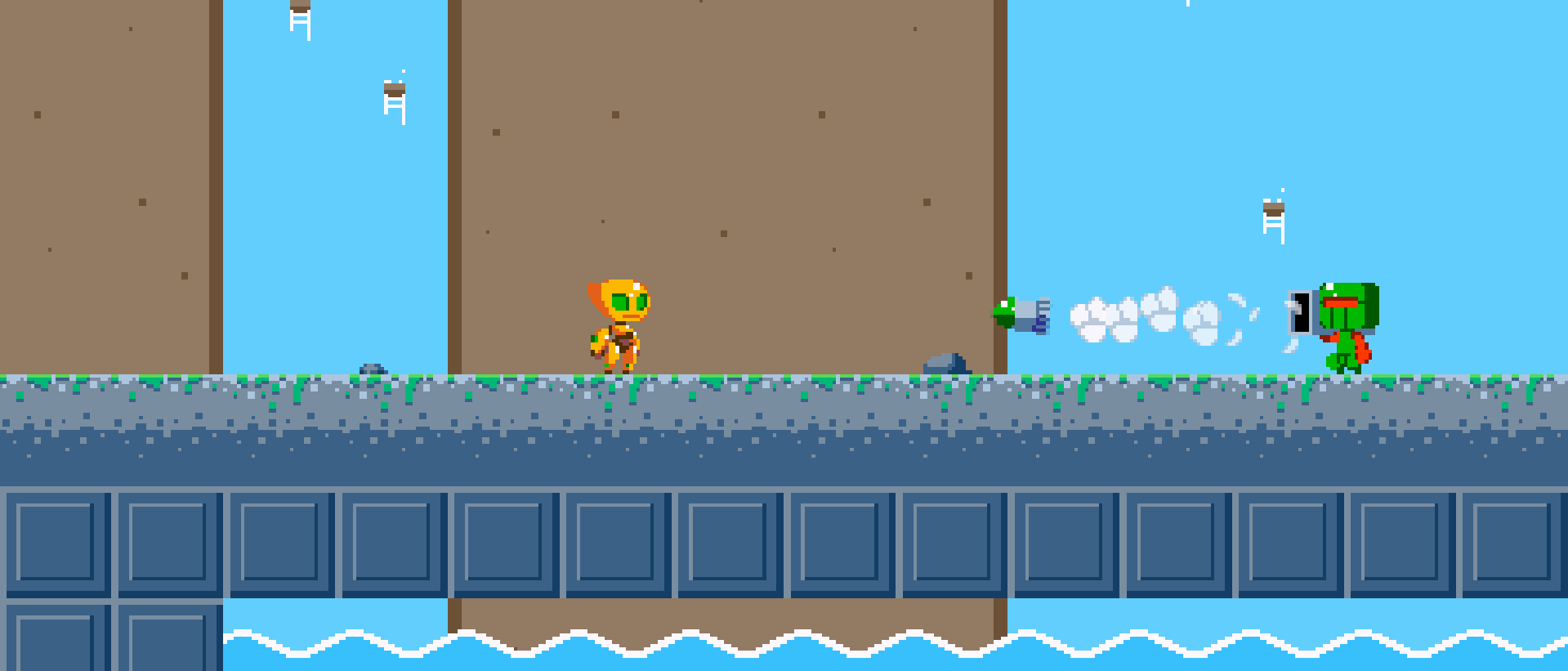
The most important thing to know about Capsized is that it is not an exploration platformer. When it was released, many people saw the beautiful hand-drawn graphics depicting a lush, alien world, and hoped the game would feature a vast planet to explore. But that is not the case; Capsized is split into discrete levels, and while there is some exploration within these levels, the primary focus is on fast-paced action. Fortunately, that action is very, very good.
Indie Platformer Marathon: Celestial Mechanica

The third platformer on my list is Celestial Mechanica, which is the result of a collaboration between Roger Hicks, known for the game rComplex, and Paul Veer, who animated the excellent Super Crate Box. It originally came out sometime in 2011, I think, but I never got around to picking it up despite being intrigued by the footage I’d seen. Then, not long ago, it was released for free, which finally convinced me to grab it and check it out.

It’s a fitting third entry to the marathon; since I’ve already covered a super-hard platformer and a puzzle platformer, it’s time for another extremely popular subgenre: the exploration platformer.

Indie Platformer Marathon: Thomas Was Alone

After finishing with Dustforce, the next platformer on my list was Thomas Was Alone, which has been getting rave reviews from pretty much everyone. It’s a puzzle platformer, which is a very popular sub-genre these days, especially amongst indie developers. Players take control of Thomas, a small red rectangle, and his quadrilateral friends as they work to escape the strange platforming environments they’ve founds themselves in. Each character, in addition to having a different shape, behaves differently: some can jump quite high while others have special abilities such as being able to float in water. To escape the various levels, players must use each character’s unique abilities to help everyone reach the exit points.

All of this adds up to an interesting little puzzle game, but Thomas Was Alone becomes much more than that due to some top-notch writing. Delivered primarily through excellent narration by Danny Wallace, it imbues those little rectangles with distinct personalities, quirks, motivations, and worries. I found myself caring more for the abstract shapes in Thomas Was Alone than I have for nearly any other game character I could name.

Indie Platformer Marathon: Dustforce

Please remember that you can click on all images for larger versions.

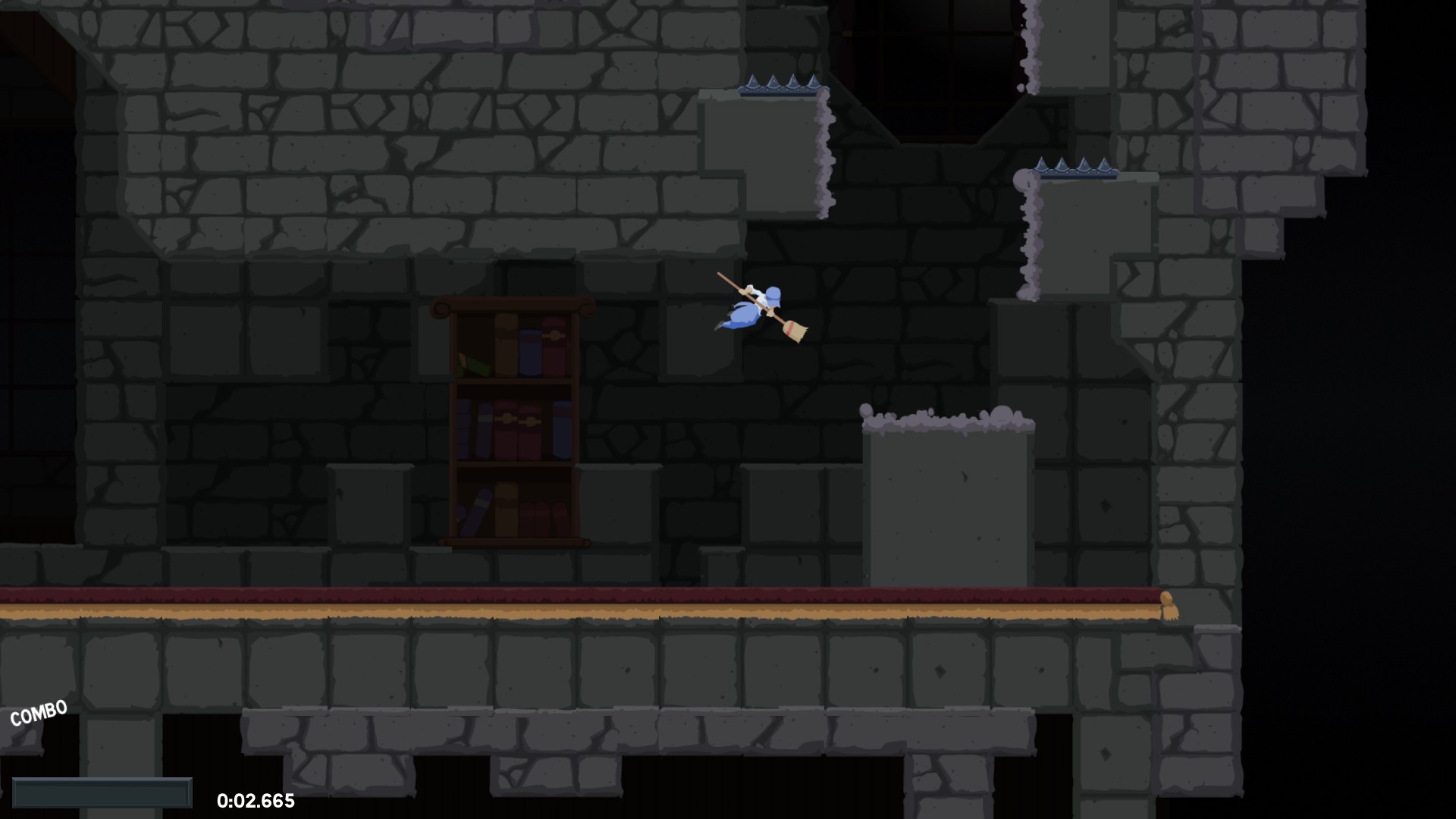
I’ve been writing about a lot of indie games lately, but most have been small, quick games that I messed around with whilst playing through something bigger, like Dishonored. This means I’ve been collecting quite a few medium- to long-length indie games that I haven’t been getting to. Looking through my disturbingly large backlog, I noticed that many of these indie games happen to be platformers. So, I decided I should just sit down and play through a whole bunch of them. How many indie platformers can I stand, before I need to play something else? We’re about to find out. First up is Dustforce, a game I am finally playing more than a year after I purchased it.

Dustforce is a game about kung fu janitors.

Indie Time: Jelly No Puzzle

Do you find that sometimes you must perform boring, repetitive tasks, that don’t really require much thought? Do you need to take an occasional break from such activities to exercise your brain a little? If so, Jelly no Puzzle provides an excellent means.

It has an extremely simple premise: each single-screen level is populated by different color jellies, which can be moved left or right. When jellies of the same color meet, they merge into a larger jelly. The goal is to bring all the jellies of the same color together. That’s it. But don’t think that it’s going to be easy. Jelly no Puzzle is actually one of the toughest puzzle games I’ve played in a long time. My elation at solving a level was followed immediately by disbelief that any human could actually have designed it. Ordinarily, I would have found the game quite frustrating, but a few simple design choices prevented this, and kept me coming back for more.

Indie Time: Footbrawl Quest

The game development competitions over at TIGSource are always a good time. With a specific theme and a strict time limit, entries are usually impressive, amusing, or both, and a few have even gone on to become commercial titles, like Realm of the Mad God and Eversion. There hadn’t been a competition in a while, so I was excited when a new one, the Sports Compo, was hosted back in November (with voting in December). Of course, I was so busy with other games that I didn’t have a chance to look at any of the entries, but I finally got around to trying the winner, Footbrawl Quest.

And seriously, just look at that screenshot. You know you want to play this.

Roguelike Highlights: Caves Of Qud

Readers who are unfamiliar with roguelikes may wish to read my introduction first. Also, please remember that you can click on all images for larger versions.

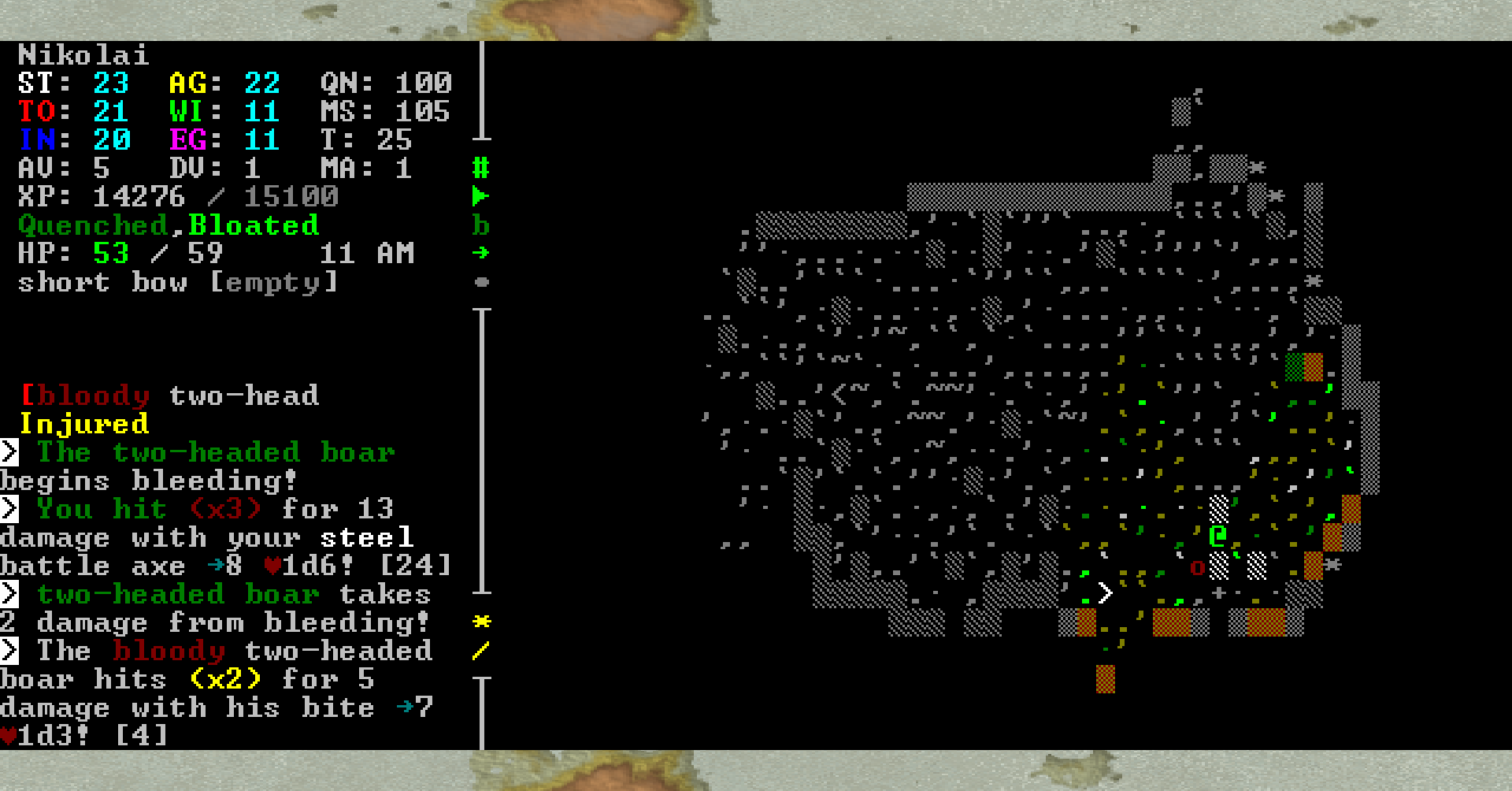
I first tried Caves of Qud many years ago, but I didn’t really get into it at the time. I saw it mentioned somewhere on the internet recently and decided to give it another go, and this time I really got sucked in. My posts have been late because I’ve been playing it instead. I can safely say it’s the most I’ve enjoyed a roguelike in a long time.

It’s tempting to describe Caves of Qud as a “post-apocalyptic sci-fi survival roguelike”, but that description doesn’t really do it justice. In most post-apocalyptic settings, the cataclysm is a fairly recent event, with survivors eking out an existance in the aftermath. In Caves of Qud, however, a thousand years or so have passed since mankind wielded its ancient, wondrous technological marvels and enjoyed dominion over the Earth. Various societies have risen since, but the jungles of Qud remain wild, inhabited by all manner of strange, mutated flora and fauna, and sheltering ancient treasures in the massive chrome caverns beneath the surface. Apparently drawing inspiration from the pen-and-paper role-playing game Gamma World (which I’d never heard of until now), Caves of Qud casts you as an adventurer seeking fame and fortune by exploring Qud and recovering these ancient relics.

Indie Time: Thirty Flights Of Loving

Remember that you may always click on images for larger versions.

After finishing Gravity Bone I immediately purchased the sequel, Thirty Flights of Loving, because I wanted to see where Blendo Games took things next. And because everyone else was making quite a fuss about it. Turns out that Thirty Flights of Loving is a rather loose sequel that doesn’t have many obvious connections, story-wise, to the first game. Having said that, playing it is quite the experience. Even more so than Gravity Bone, Thirty Flights of Loving is unlike anything else you have played, and for that alone it is well worth your attention.

Indie Time: Gravity Bone

There’s been quite a lot of talk amongst game-playing types recently about Thirty Flights of Loving, a very short but allegedly very excellent game that does a lot of interesting stuff with storytelling. But what really caught my attention was the fact that it’s the sequel to Gravity Bone (look for the link at the bottom of that page), a game I’d read about many years ago but never got around to trying. I was also delighted to discover that both titles are brought to us by Blendo Games, a developer I became familiar with when trying out the rather relaxing Flotilla.

Clearly, it was time to correct my earlier negligence and play through Gravity Bone.

Indie Time: Corrypt

Now that I’ve finished playing Dishonored (for now, anyway), I started up another big-budget game. But I won’t be able to post about it. Fortunately, I have a backlog of shorter indie games I’ve been meaning to write about. First up is Corrypt, which was making noises in the indie scene a few weeks ago.

Corrypt is a puzzle game. You move your character around the screen one square at a time, pushing boxes around, like you’ve done in many other such games. This time you will also pull boxes, which might seem like a minor detail but was actually a big enough change to keep me stumped in quite a few puzzles. At these times I appreciated being able to explore other parts of the world and try my hand at a different puzzle for a change. Soon I was making good progress, and enjoying the rather strange visuals and excellent music.

If that was all Corrypt was, it would still be worth a look. But it soon became apparent that Corrypt is much, much more.

Page 24 of 34

Powered by WordPress & Theme by Anders Norén