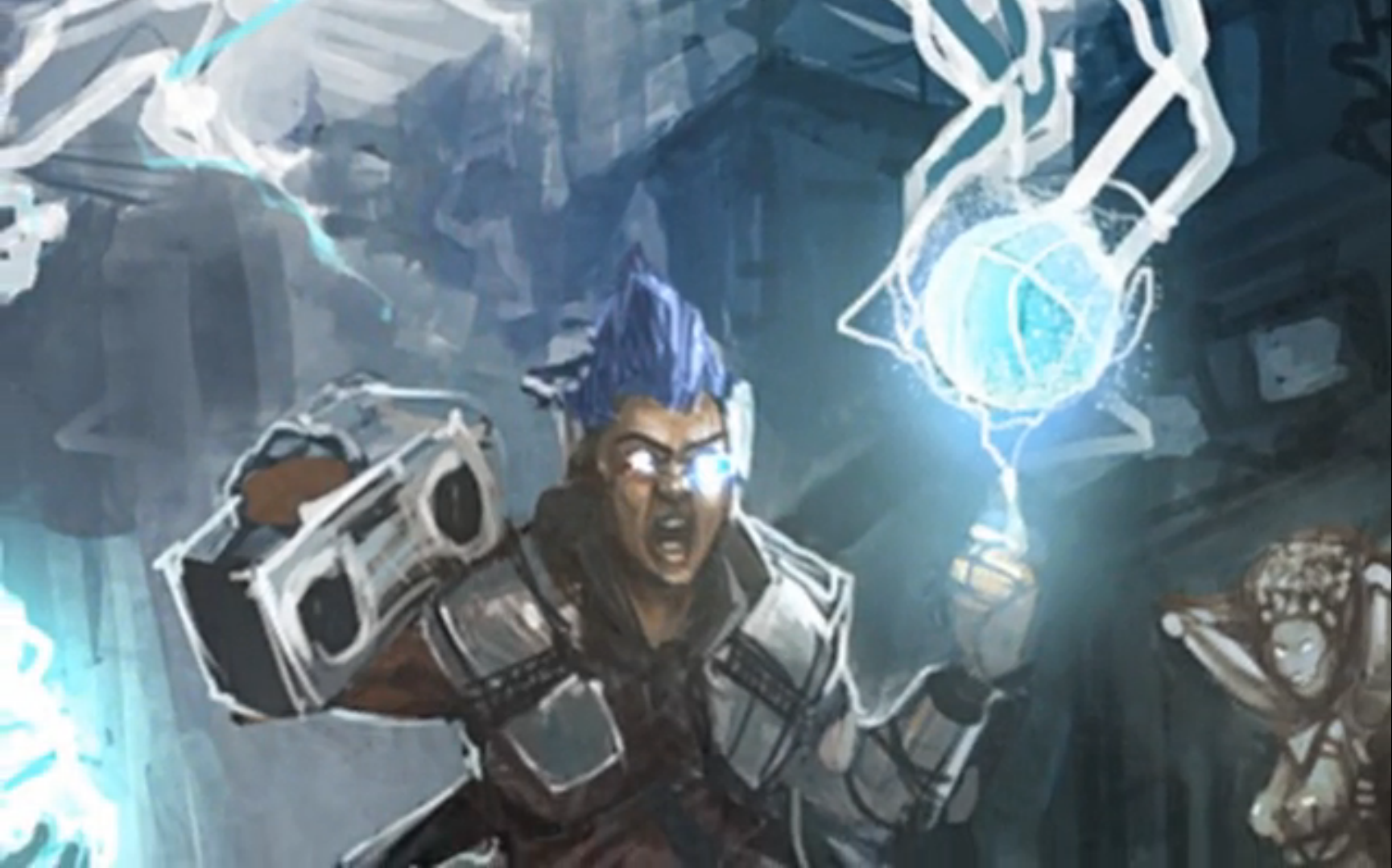
After posting my initial impressions of Dishonored, I’ve gone back and finished the game, so I’m now qualified to comment on it as a whole. While my first post spent a lot of time comparing the game to the Thief series, after playing further that sense of similarity disappeared. Dishonored is still clearly an homage to the Thief games, but it has its own character that shone through. And it’s absolutely worth experiencing.
Author: waltorious Page 25 of 34
Longtime readers may recall that I was quite impressed with Might and Magic Book One, a game originally released in 1986, when I played it for the first time a few years ago. Impressed enough, in fact, that I honored it with the very first History Lessons post on this blog. Well, it turns out I’m not the only one who likes that particular brand of old-school role-playing. Swords and Sorcery — Underworld Gold is an homage to the first two Might and Magic games, created (as they were) by a single person.
Now, the word “homage” does not fully capture just how similar Underworld is to those early games. The six-character party, the first-person turn-based movement, the 16×16 grid maps, the combat system, and even many specific spells are pretty much copied from the first Might and Magic games. In fact, the original version of Underworld had almost no graphics, just like Might and Magic Book One. Underworld creator Charles Clerc later made a slew of design changes and bug fixes, and hired an artist to redo all the graphics, resulting in the newer, shinier Gold edition.
Actually, let’s talk about those graphics first.

Endless Forms Most Beautiful has an interesting history. It was originally released by Dave Hughes early in 2012 for the ZX Spectrum. Yes, the ZX Spectrum, a machine that first hit the market in 1982. There is still a community developing for the Spectrum over at World of Spectrum, although I imagine many of the games are actually played through emulation these days.
Anyway, Locomalito (known for their retro-styled freeware games like Hydorah and l’Abbaye Des Morts) were looking for a game to remake for PC, and decided that Endless Forms Most Beautiful was an ideal candidate. The port not only updates the graphics with a more recent retro aesthetic, but also apparently lowered the difficulty significantly to make it more accessible to newcomers. Now, you can play this remake of the arcarde-style game for free on your PC.
I am playing Dishonored extremely slowly. Which is amusing, because apparently one of the main complaints that certain players have brought against the game is that it is too short. I hear that this is true, provided one heads directly for the objective in each mission. But I’ve been meticulously sneaking into every nook and cranny I can find, taking my sweet time about it, such that my Steam counter says I’ve played for 15 hours already but I’ve only just finished the second mission. And since I’ve barely been able to find time to play, it’s been a really rather epic stretch of time since I first started. I’m hoping I can pick up the pace, because I’ve quite enjoyed it so far.
![]()
Released on Halloween, Megaman Sprite Game is a game made using real Megaman sprites. If you’re played any Megaman games before, you’ll immediately recognize Megaman’s toothy smile, his basketball-toting brother Zero, and of course, Megaman’s predilection for smacking ghosts.
Wait, what?
Readers unfamiliar with roguelikes may wish to read my introduction to the genre first.
I first heard about Red Rogue a few years ago, when its author, Aaron Steed, began a development log forum thread on Tigsource. Soon there was a playable build which I had some fun messing around with, but I didn’t stick with it for very long. Flash forward to last week, when out of the blue I saw the news that the game is now complete. So I decided to take another look. And my, it’s a lot more interesting now, enough so that I kept playing it instead of writing this post (apologies for the tardiness) and I imagine I’ll keep playing it for some time.
So what is Red Rogue? It’s a roguelike platformer. If you’re like me, that immediately makes you think of Spelunky, which I’ve written about before (it’s excellent, by the way, and you should definitely go play it). But while Spelunky is a platformer that borrows a bunch of roguelike elements in its design, Red Rogue is more of a roguelike re-imagined as a platformer. While exploring its procedurally-generated levels, you will find, identify and equip weapons and armor, you will walk into enemies to attack them, you will search for traps and secret passages, and you will slowly learn more about the dungeon and the rules that govern it.
Oh, and you’ll die a lot.
Ludum Dare is a recurring game development competition in which participants are given 48 hours to make a game based around the competition’s theme. The results have been surprisingly good, with the strict time limit forcing developers to focus on a solid core design for their entries, making the competition quite popular among designers and players alike. After Ludum Dare 18, a secondary competition was added called the Jam, which allows for teams and has an extended time limit of 72 hours.
The Wager was an entry in the Ludum Dare 19 Jam, with the theme of “discovery” (see the winners here). Since then, developers Surprised Man have gone back to fix bugs and add some features, and the latest version 1.2.4 is available for free from their site. The game pits the player against the dastardly Sir Lester Marwood, with whom the player has made a wager: whoever can make the most money from their maritime explorations by the end of the year 1777, wins. The player sails north, Marwood sails south. It’s on.
I feel like I’m writing about Japanese-style role-playing games disproportionately often, compared to what I’m actually playing. I think this is because, like roguelikes, they make excellent “break time” games that can be played in short, quick sessions and don’t require a significant time investment. While I’m always playing at least one large-scale game, I can’t always sit down for a serious gaming session, and sometimes these “break time” games are all I have time for. I hope to post about the other stuff I’m playing soon, but it may be small-scale games for a while.
Kevin Rudd Farming Generations is a Japanese-style role-playing game made using RPGMaker [EDIT: It was actually made using GameMaker]. I can confirm that it involves both farming and generations.