Game-related ramblings.

Tag: NES Page 2 of 3

Console History: Final Fantasy II

This is Console History, a special sub-series of my more general History Lessons series, covering console role-playing games, action role-playing games, Metroidvanias, and action-adventure games in nominally chronological order starting in the late 1980s. The chronology is garbled in the beginning as the scope of the series expanded, but it gets more organized later on. As always, you may click on images to view larger versions.

The very first game I played for this series was Final Fantasy. I had intended to play all the Final Fantasy games in order, to see how they evolved from the early games I remembered as a kid to the huge epics full of cinematic scenes they are today. But then I decided I should probably also cover the Dragon Quest series, which released first. And then I added a bunch of other Japanese-style role-playing games. And then some action role-playing hybrids. And then some Metroidvanias and Zelda-esque games. Now, after playing and writing about 30 games, I’ve finally reached Final Fantasy II, which Square released in Japan on December 17. 1988.

Console History: Blaster Master

This is Console History, a special sub-series of my more general History Lessons series, covering console role-playing games, action role-playing games, Metroidvanias, and action-adventure games in nominally chronological order starting in the late 1980s. The chronology is garbled in the beginning as the scope of the series expanded, but it gets more organized later on. As always, you may click on images to view larger versions.

My quest to play through early console role-playing games, action-role-playing hybrids, and Metroidvanias continues. I’ve got a nominal timeline, but I keep deviating from it as I add more games to the list. Now I’m finally catching up. The farthest I’ve reached is September 1988 with Spellcaster, before that was Exile in August, and before that was Blaster Master in June 1988 — a mere two weeks after our last entry, Cosmo Police Galivan. Since I’ve covered Exile already, Sunsoft’s Blaster Master is the last game on the list that predates Spellcaster; after this, I’ll be moving forward with the nominal timeline and entering the tail end of 1988.

I actually played Blaster Master as a kid. I never owned a copy, but a friend did, and we played it together on his NES. I don’t remember if we ever reached the end, but we did get pretty far. So it was a bit of a nostalgia blast (heh) to play it again now.

Console History: Cosmo Police Galivan

This is Console History, a special sub-series of my more general History Lessons series, covering console role-playing games, action role-playing games, Metroidvanias, and action-adventure games in nominally chronological order starting in the late 1980s. The chronology is garbled in the beginning as the scope of the series expanded, but it gets more organized later on. As always, you may click on images to view larger versions.

For those just tuning in, I’ve been playing through early console role-playing games, action role-playing hybrids, and Metroidvanias, but since I keep adding more games to my list the timeline has gotten a bit muddled. The farthest I’ve reached is September 1988 with Spellcaster, but since then I’ve gone back to fill in some games I missed. Most recently that was The Battle of Olympus. If I’d done things in order, The Battle of Olympus would have been followed by Ys II and Lord of the Sword, before bringing us to this post about Cosmo Police Galivan, by Nihon Bussan.

Inspired by Japanese tokusatsu television series Space Sheriff Gavan and Space Sheriff Sharivan, Cosmo Police Galivan was originally a 1985 arcade action platformer game. On June 3, 1988, a Famicom port appeared with drastically different gameplay. While still focused on platforming action, it added role-playing mechanics and nonlinear environments reminiscent of Metroid, that require protagonist Galivan to seek out new weapons and abilities in order to open up new paths. It was never released outside of Japan, but fortunately there’s a fan-made translation patch allowing English speakers to play it via emulation (I used the Retroarch frontend and Mesen emulation core, as usual for Famicom/NES games). It sounded interesting, so I decided to give it a go.

Console History: The Battle Of Olympus

This is Console History, a special sub-series of my more general History Lessons series, covering console role-playing games, action role-playing games, Metroidvanias, and action-adventure games in nominally chronological order starting in the late 1980s. The chronology is garbled in the beginning as the scope of the series expanded, but it gets more organized later on. As always, you may click on images to view larger versions.

I’m still rectifying the timeline for this series. After reaching September 1988 with Spellcaster, I realized I’d skipped over some games that should really be included, and went back to cover them. Most recently, that was Sorcerian, released in late December 1987. Thus we now enter 1988 once again. Following Sorcerian in the timeline should be Dragon Quest III, which I’ve already written about, and now The Battle of Olympus, which released in Japan on March 31, 1988, and was later brought to the US by Broderbund in January 1990.

I’d originally skipped over The Battle of Olympus because I’d seen it referred to as a clone of Zelda II, suggesting it had little of its own to offer. After reading more about it, I decided to include it anyway, and I’m glad I did. It does have a lot of similarities with Zelda II, but it manages to feel like its own game despite them.

Console History: Faxanadu

This is Console History, a special sub-series of my more general History Lessons series, covering console role-playing games, action role-playing games, Metroidvanias, and action-adventure games in nominally chronological order starting in the late 1980s. The chronology is garbled in the beginning as the scope of the series expanded, but it gets more organized later on. As always, you may click on images to view larger versions.

For those just tuning in, I’ve been playing early console role-playing games (and some adjacent games) for this sub-series of my broader History Lessons series. I’m nominally trying to go chronologically by the original release date (which is usually the Japanese release date) but I keep expanding the scope to include more games, so I keep jumping back and forth. The farthest I’ve made it in time is SpellCaster for the Sega Master System, which released on September 23, 1988. But I’m currently on a trip back to 1987 to fill in a few games I realized I should have included. The most recent of these is Faxanadu, by Hudson Soft, which released in Japan on November 16, 1987, and was later brought to the US in August 1989.

Console History: Rygar

This is Console History, a special sub-series of my more general History Lessons series, covering console role-playing games, action role-playing games, Metroidvanias, and action-adventure games in nominally chronological order starting in the late 1980s. The chronology is garbled in the beginning as the scope of the series expanded, but it gets more organized later on. As always, you may click on images to view larger versions.

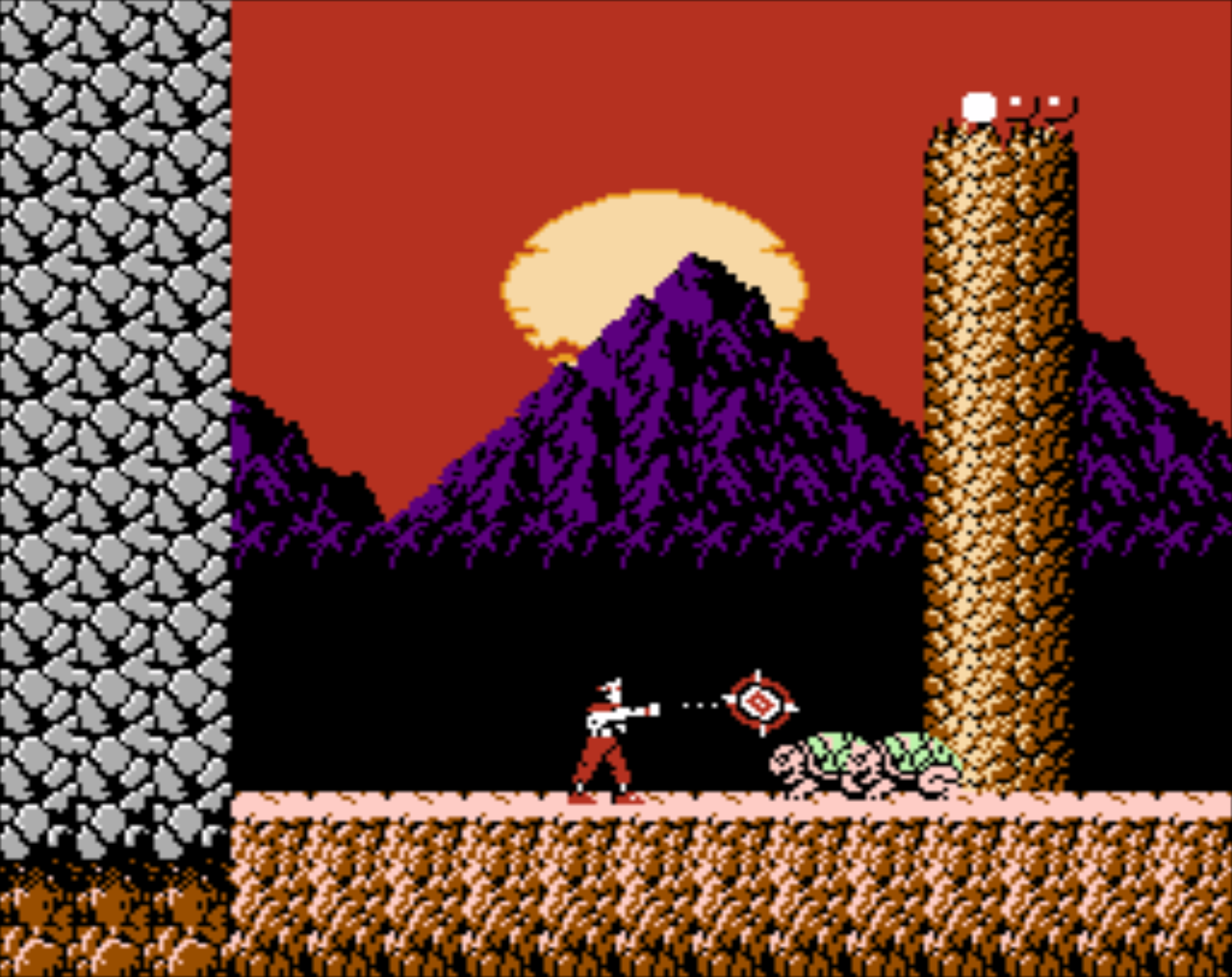
For those just tuning in, I’m taking a detour from the nominal timeline of this series. I say “nominal” because I’ve completely failed to be chronological so far. While I started out focused on early console role-playing games, this quickly expanded to include action role-playing hybrids, and now early Metroidvania games (including Metroid and Castlevania II: Simon’s Quest themselves). Having learned about some more early titles that experimented with this nonlinear open world platformer style, I’ve gone back to play a few. That means that of the 24 games I’ve covered so far, Rygar is actually the 9th in order of Japanese release date. It arrived in April 1987, almost exactly one month after The Goonies II, which I wrote about last time. It only took three months to get a US release, however, meaning it actually made it to the States about four months ahead of The Goonies II.

Console History: The Goonies II

This is Console History, a special sub-series of my more general History Lessons series, covering console role-playing games, action role-playing games, Metroidvanias, and action-adventure games in nominally chronological order starting in the late 1980s. The chronology is garbled in the beginning as the scope of the series expanded, but it gets more organized later on. As always, you may click on images to view larger versions.

It was inevitable. Last time, I broke from my timeline to play Dragon Slayer IV: Drasle Family (AKA Legacy of the Wizard), a game I’d originally skipped over because I’d deemed the Dragon Slayer series to be too early, and too focused on home computer systems instead of consoles. When this blog series expanded in scope, I decided I should probably go back and play a few of the Dragon Slayer games. But with Dragon Slayer IV I didn’t just find a great melding of role-playing and platforming action, I found one of the games that helped define the Metroidvania genre, and a very impressive one at that. From there, I started reading about some other early games that built the foundations for Metroidvanias, and since I’d already covered Metroid and Castlevania II: Simon’s Quest, I figured I might as well go back and play these other early games too. I promise I’ll get back to my timeline eventually.

First up is The Goonies II, by Konami, which was actually quite early. Released in March 1987 (coming to the US that November), it slots after Esper Dream (also by Konami) in my timeline, and the only platformers I’ve covered that predate it are Metroid and Zelda II: The Adventure of Link. That means it got in on defining nonlinear, exploratory platforming before Castlevania II: Simon’s Quest would add the “vania” to the Metroidvania genre. But that was also by Konami, so I guess they were just building on their own work. Perhaps the most interesting thing about The Goonies II, however, is that it combines platforming with first-person adventure sequences, much like Sega’s Spellcaster would do a year and a half later.

Console History: Dragon Slayer IV: Drasle Family (AKA Legacy Of The Wizard)

This is Console History, a special sub-series of my more general History Lessons series, covering console role-playing games, action role-playing games, Metroidvanias, and action-adventure games in nominally chronological order starting in the late 1980s. The chronology is garbled in the beginning as the scope of the series expanded, but it gets more organized later on. As always, you may click on images to view larger versions.

I wasn’t planning to cover any of Nihon Falcom’s Dragon Slayer games for this series. The first Dragon Slayer appeared way back in 1984 for the Japanese PC-88 home computer (and, later, other home computers like the PC-98 and FM-7), where it pioneered an action role-playing design in which players explore top-down screens in real time, bumping into enemies to fight them. This design was hugely influential, inspiring the Hydlide series (I covered the third game as part of this blog series) as well Nihon Falcom’s own Ys series (I covered the first two games) and Nintendo’s The Legend of Zelda, which added innovations that arguably spawned a whole new genre. But Dragon Slayer itself sounded quite simple in comparison to these later titles, as well as potentially frustrating due to high difficulty or unclear objectives. And, of course, most of the Dragon Slayer games were never translated into English. So, early on in my planning sessions I decided to exclude them.

Then I read more about some of the later Dragon Slayer games that were eventually localized in English, which sounded much more interesting than I expected. So, I’m breaking from my timeline once again to go back and play a couple of them. The first is Dragon Slayer IV: Drasle Family (that stands for DRAgon SLEyer Family, of course), originally released in July 1987 for the MSX and MSX2 home computer systems, and later ported to Nintendo’s Famicom (for this blog series, it comes after Wonder Boy In Monster Land and before Cleopatra no Mahou in the timeline). Since American players had never seen any of the Dragon Slayer games before, it was renamed Legacy of the Wizard for its official US release on the NES about two years later. It keeps the single-square-sized characters and blocks from the original Dragon Slayer, but reimagines the labyrinthine dungeon as a huge side-scrolling platformer world, in which ledges, pits, ladders, and doors intertwine to create different paths. Players then choose from (and switch between) five playable family members, each with different abilities and usable items, so the entire game becomes a puzzle the family must solve together. Following on from Metroid, which had released about a year earlier, Dragon Slayer IV helped define what would become known as the Metroidvania genre. It sounded fascinating, and I decided I had to try it.

Console History: Castlevania II: Simon’s Quest

This is Console History, a special sub-series of my more general History Lessons series, covering console role-playing games, action role-playing games, Metroidvanias, and action-adventure games in nominally chronological order starting in the late 1980s. The chronology is garbled in the beginning as the scope of the series expanded, but it gets more organized later on. As always, you may click on images to view larger versions.

When I wrote about Ys II: Ancient Ys Vanished – The Final Chapter, I celebrated finally getting my timeline in order for this series. I had started haphazardly, playing things and then realizing I should add other games that had come before, resulting in awkward jumps back and forth in time. With that post, however, I had finally finished playing catch up, and everything should have been in nice chronological order moving forward. But it only took one more post — about Sega’s Master System game Lord of the Sword — to make me realize I had to jump back in time again. Lord of the Sword’s design, which is basically an action platformer game but set in an open world inspired by role-playing games, reminded me of Castlevania II: Simon’s Quest, a game I really should have covered already. I wrote about Metroid, after all, and Simon’s Quest is the game that added the “vania” to Metroid to create the “metroidvania” genre.

Console History: Cleopatra No Mahou (The Cursed Treasure Of Cleopatra)

This is Console History, a special sub-series of my more general History Lessons series, covering console role-playing games, action role-playing games, Metroidvanias, and action-adventure games in nominally chronological order starting in the late 1980s. The chronology is garbled in the beginning as the scope of the series expanded, but it gets more organized later on. As always, you may click on images to view larger versions.

When I started this series about console game history, the first game I wrote about was Final Fantasy. That was before I got more organized and realized there were older games I wanted to cover as well. Games like Cleopatra no Mahou (which translates roughly to “The Cursed Treasure of Cleopatra”), the first role-playing game that Square made, before getting their breakout hit with Final Fantasy. The story goes that the “Final” in Final Fantasy referred to the fact that it may well have been Square’s final game, although that may not be wholly accurate. But Square were in financial trouble at the time, because their earlier games hadn’t sold well. I wanted to play Cleopatra no Mahou not only to see what Square’s early foray into the role-playing genre was like, but also because I was intrigued by its modern day Egyptian setting and blending of role-playing design with adventure game elements.

Page 2 of 3

Powered by WordPress & Theme by Anders Norén