Game-related ramblings.

Author: waltorious Page 26 of 34

Barkley, Shut Up And Jam: Gaiden Is Getting A Sequel

I don’t usually do news posts (well, maybe the Roguelike Updates posts qualify), but this is important. Barkley, Shut Up And Jam: Gaiden, everyone’s favorite Japanese-style RPG about the last living b-ball stars and their struggle to survive in the post-cyberpocalypse, is getting a sequel.

Developer Tales of Game’s announced the sequel six days ago (I apologize for my tardiness), and give the full title: The Magical Realms of Tír na nÓg: Escape from Necron 7 – Revenge of Cuchulainn: The Official Game of the Movie – Chapter 2 of the Hoopz Barkley SaGa. Apparently it will be an action role-playing game, with an open world that can be explored in non-linear fashion, and will star X114JAM9, “an amnesiac baller with no recollection of his past and no concept of his incredible b-ball destiny.” I took the liberty of grabbing the announcement graphic for use at the top of this post; I don’t think Tales of Game’s will mind. They’re planning a Kickstarter campaign to help fund development, and I’ll be sure to announce that once it launches.

Now, if you’ve played Barkley, Shut Up And Jam: Gaiden, then you probably don’t need any more information than that to get very excited indeed. If you haven’t played Barkley, Shut Up And Jam: Gaiden, then you should do so immediately.

Why, you ask? Let me tell you.

Roguelike Updates: Who Needs Leveling, Anyway?

It’s time for another roundup of updates to the various roguelikes I’ve covered on this blog. The big news is that Brogue has reached v1.7, with some major changes.

With the exception of its scrolls of enchantment — which allowed players to customize their characters not by some up-front character generation choices but by which pieces of equipment they chose to enchant — Brogue was quite similar to the original Rogue on first release. But the scrolls of enchantment were a great idea, and the strict rationing of these scrolls created strategic dilemmas not found in other roguelikes. By the time I wrote about it, other features of Brogue had already started to follow suit. The player character’s strength (and therefore, ability to use heavier weapons and armor) was no longer tied to experience level, instead being granted by potions of strength which were rationed just like scrolls of enchantment. This meant that it was no longer necessary to fight lots of enemies before getting to use better equipment, and stealthy tactics were more viable.

Still, fighting monsters for experience points to gain levels remained at the core of Brogue, and gaining levels was the only way to gain more health. Until now. With v1.7, leveling has been completely removed from the game.

Behind The Times: Torchlight

Please note that, like always, you can click on the screenshots for bigger versions.

I originally intended to finish playing Torchlight in time for the release of Torchlight 2. Then I injured my wrist, and since Torchlight is a 2-handed game, I had to take a break and play other things. Now, I’ve gone back and finally finished it.

Before I start, a little history: I’ve written many posts on roguelikes, and several more on roguelike-likes, games that borrow design elements from roguelikes and fuse them into other gameplay styles. But the most famous roguelike-like was Blizzard’s 1996 game Diablo. Diablo took the dungeon-crawl premise of most roguelikes — complete with procedurally generated floors, hordes of enemies to fight, and heaps of randomized loot to find — and fused it with a fast-paced real-time combat system. While Diablo did not feature perma-death like most roguelikes, where dying meant starting the whole game over, it did offer serious consequences for failure: there was no manual save system, with the game instead saving automatically when quitting, so it was never possible to reload an old game to reverse a mistake. Dying meant respawning in town without any of your stuff, and having to make a dangerous run to your corpse to recover it. This kept the tense feel of a roguelike without punishing the player too harshly for not having clicked on an enemy quickly enough. [EDIT: Diablo II did feature an optional “hardcore” mode with permadeath — thanks to jefequeso for pointing this out.]

Diablo was an instant hit, spawning its own genre known as the action role-playing game (abbreviated to action-RPG or ARPG). Today, nearly all role-playing games are called action-RPGs because they tend to feature real-time combat systems that play out similarly to action games, but back in 1996 the term applied exclusively to Diablo clones. And there were many, although none managed to unseat the Diablo series as the leader of the genre. Torchlight is a more recent Diablo clone, and has the distinction of being developed by some of the same people who worked on Diablo and Diablo II. While I enjoyed the Diablo games (mostly having played the second), I was never that interested in their dark, demon-filled world. Torchlight’s colorful locales were much more enticing.

Indie Time: Moustache King Adventure

My wrist has recovered enough to allow me to play two-handed games again! I’m playing a few at the moment, but I’m not ready to write about them yet, so I wasn’t sure what to post about. Then I played Moustache King Adventure.

Moustache King Adventure was an entry in the latest A Game By Its Cover competition, in which developers must make a game based on a fake game cartridge (in this case, it was this cartridge). The first A Game By Its Cover competition was hosted over at Tigsource (an indie games site run by Derek Yu, of Spelunky fame), and brought us such classics as Cat Poke and Under the Garden (which is, incidentally, getting a full-blown sequel called Under the Ocean). It seems that the A Game By Its Cover competition has since spun out on its own, with a dedicated website and everything. In this second contest, entrants had one month to make their games from scratch, so most of the games are simple and short. Moustache King Adventure is no exception, but it’s an enjoyable way to spend a few hours. It also has 400% more moustaches than the average game.

Roguelike Highlights: Iter Vehemens Ad Necem

New readers may wish to read my introduction to roguelikes first. Also, know that you can click on the screenshots for larger versions.

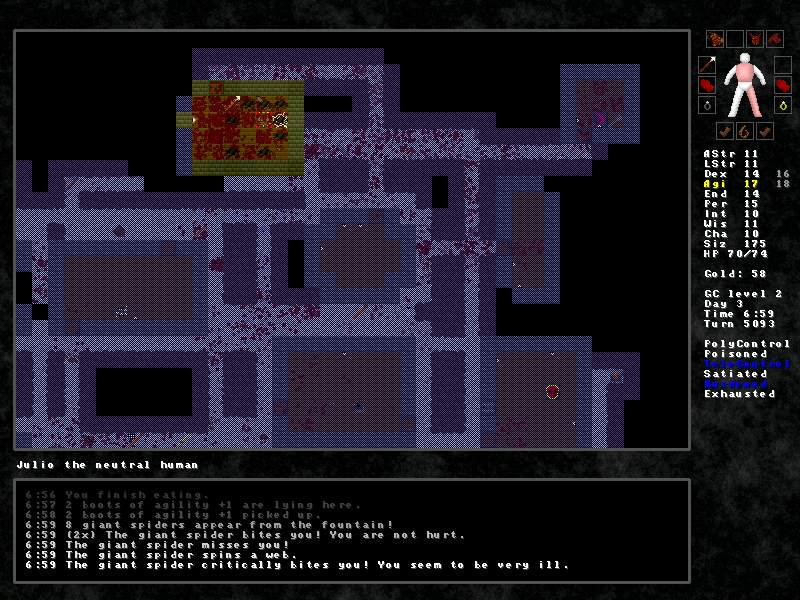
“Iter vehemens ad necem” is a Latin phrase meaning “a violent road to death”. The game Iter Vehemens ad Necem, known as IVAN for short, is a roguelike that is aptly named. Most roguelikes are hard, and end with the player’s death the vast majority of the time, but IVAN takes a special, cruel pleasure in killing the player in the most violent ways possible. A typical session might see you get caught in a spider’s web, poisoned by said spider, and left to die slowly, vomiting the whole time. Or you might get stuck in a bear trap and assaulted by a zombie that gives you leprosy, so you must watch helplessly as your limbs fall off, until the leg with the trap on it falls off, which frees you… but then you have to try and roll around without limbs and eventually starve to death. Or a kamikaze dwarf might detonate next to you, causing the wands you’re carrying to explode, blowing your arms and head off and leaving your corpse to dissolve slowly in a cloud of acid rain.

Sound like fun?

You Shouldn’t Play Vigil: Blood Bitterness

Okay. I bought Vigil: Blood Bitterness several years ago for about $1 during a super-sale, which saw the entire Meridian4 catalog going for very cheap. I checked out the sale for Shadowgrounds (which is an excellent game) but decided to browse the rest of the catalog, and Vigil: Blood Bitterness caught my attention due to its stark black and white visual style. The description implied a point-and-click adventure game, set in a strange futuristic world with a dark and forboding atmosphere. I decided it was worth $1 to check it out, but then I promptly got distracted by all sorts of other games, and only got around to trying it recently.

I actually played it before I injured my wrist, but given that it is entirely controlled with the mouse you could easily play it with one hand. But you shouldn’t.

Roguelike-like: FTL

Readers who are unfamiliar with roguelikes may wish to read my introduction on the subject first.

It seems that everyone in the world is playing FTL. It’s one of the first Kickstarter games to be finished (although it was already under development before its Kickstarter campaign), and it’s captured everyone’s imagination. It’s easy to see why: a spaceship management game, which has the player shunting power to different systems and frantically ordering crew-members to put out fires, all while making Faster Than Light (FTL, get it?) jumps to escape the rebel fleet, is something we don’t usually see. The roguelike elements — the randomized encounters and brutal difficulty that force the player to try and try again — seal the deal. Best of all, it can easily be played with one hand, being almost entirely mouse-controlled. The only key needed is the spacebar, for pausing the action to issue orders, and if you’re like me you even go to the trouble of mapping that to a spare button on the mouse [EDIT: I had to use my programmable mouse to do this; the game does not actually allow for remapping controls] for a true one-handed experience (if you’re not like me, it’s OK; reaching over to the spacebar with one hand is still very easy).

Most who have written about FTL focus on the great player-generated stories it facilitates. Here’s one example; here’s another. Since I’ve already done that extensively for my favorite roguelike, I won’t take that approach here. Instead I’m going to talk about FTL’s design, and why I think it works so well.

History Lessons: Master Of Magic

New readers may wish to read my History Lessons Introduction first. Previous History Lesson posts can be found here.

I couldn’t stay away. At first I thought I’d just take a break from games while my wrist healed, but soon I gave in and started looking for games I could play with one hand. Fast-paced action games were out of the question, unless I could play them entirely with the mouse, so I started looking at turn-based options. Roguelikes would work, of course, but I wanted something with a longer playtime. Eventually I settled on Master of Magic, the 1994 fantasy-themed strategy game by Simtex. While Simtex are perhaps more famous for creating the first two Master of Orion games, Master of Magic garnered a loyal community of fans, many of whom are still playing it today.

Most players describe Master of Magic as a fantasy version of Sid Meier’s classic Civilization series, and while Master of Magic certainly has its differences, the description is fairly accurate. Much like Civilization, players in Master of Magic start off with a single city and must expand their empire by managing production of buildings and armies, exploring the world map, founding or conquering new cities, and eventually encountering other empires controlled by computer players. But this all takes place in a fantasy world, where the players are powerful wizards and there are all manner of monstrous creatures to encounter or recruit as they vie for supremacy. And best of all, it can be played entirely with the mouse, and it’s all turn-based so I have as much time as I need to make decisions. Perfect!

Blog Takes Break

A wrist injury makes it hard to type and impossible to play most games, so the blog will be taking a break while that heals. Feel free to look through the archives in the meantime; there are 78 posts to check out if you haven’t already.

Roguelike Highlights: Mercury

If you haven’t already, you may wish to read my Introduction to Roguelikes. Previous Roguelike Highlights can be found here.

I’ve been pretty busy recently so I haven’t had much time to post, but I wanted to at least write something quick about Mercury. While most Roguelike Highlights are fairly long and detailed, this one doesn’t have to be, because of the central premise of Mercury. It’s a winner-generated roguelike. Rather than being continuously updated by the developer, as most roguelikes are, Mercury instead tracks players’ high scores, and at the end of each cycle (I think cycles are two weeks long but I’m not sure) the two players with the highest scores can add a new character class, monster, or item to the game. Then everyone plays with the new stuff for the next cycle, and the new high scorers will get to add more stuff when that cycle ends.

That means that Mercury started off as a very simple game, with only one character class, one type of monster, and one item. Since then, it’s grown quite a bit.

Page 26 of 34

Powered by WordPress & Theme by Anders Norén